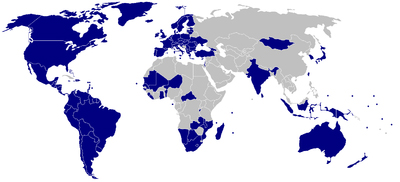
 The primary task of an association, through its board of directors, is to maintain, repair and replace the common areas, which protects the property values of its members. Even though homeowners associations are often viewed as quasi-governmental in nature, they are not pure democracies where members can vote on all issues. Instead, powers are delegated to elected representatives (the board of directors) with some powers are reserved to the membership. This is the model used throughout much of the world (see blue areas on adjacent map).
Membership Rights. The rights/powers reserved to association members are described in the governing documents and generally include the right to:
- Access their property (ingress-egress)
- Amend the CC&Rs and bylaws
- Approve significant capital improvements
- Approve regular assessments over 20%
- Approve special assessments over 5%
- Approve exclusive use easements to members
- Attend open board meetings
- Call special meetings of the membership for a lawful purpose
- Display noncommercial signs
- Display the U.S. flag
- Dissolve an association
- Elect a board of directors
- Enforce the CC&Rs
- Inspect the association's records
- Install drought tolerant plants
- Install electric charging stations
- Install a satellite dish
- Install solar panels
- Modify common areas for disability access
- Own a pet
- Petition the board
- Receive disclosures
- Receive due process for rules violations and reimbursement assessments
- Receive the membership list
- Remove directors from the board
- Reverse a rule change
- Right to improve property
- Serve on the board
- Use the common areas
- Exercise any other powers reserved to the membership via the governing documents or applicable laws.
No Veto Power. Because of the division of power between the membership and the board, members do not have a direct veto over the board's decisions (except for rule changes). Rather, the power to veto is indirect. If members are unhappy with board actions (or inaction), they have various options available to them.
Association's Authority. "Unless the governing documents provide otherwise, and regardless of whether the association is incorporated or unincorporated, the association may exercise the powers granted to a nonprofit mutual benefit corporation, as enumerated in Section 7140 of the Corporations Code." (Civ. Code § 4805(a).) Corporations are required to have a board of directors who conduct the affairs of the corporation. (Corp. Code § 300.) Because of their positions of authority, boards (and individual directors) are held to a higher standard as fiduciaries. Unless the governing documents provide otherwise, boards can:
- Adopt and enforce rules and regulations
- Appoint committees
- Appoint directors to fill vacancies
- Approve exceptions to exclusive use easements
- Borrow money
- Call membership meetings
- Appoint inspectors of election
- Communicate with the association's attorney
- Delegate management
- Disburse reserve monies
- Elect and remove officers
- Enforce the governing documents
- Enter into contracts
- Establish architectural standards
- Exercise the powers of a corporation (Civ. Code § 4805; Corp. Code § 7140)
- Hire and fire employees and vendors
- Initiate and defend lawsuits
- Insure the association and its directors
- Invest funds
- Levy and collect regular, special, and emergency assessments
- Make limited capital improvements
- Manage the association
- Pay expenses incurred by the association
- Prepare and adopt budgets
- Repair and maintain the common areas.
Judicial Deference. Courts will defer to board decisions, even if the decisions are not the "best" decisions, provided the board made a reasonable investigation and its decision was in good faith with the best interests of the association in mind (Business Judgment Rule). Members who are unhappy with board decisions always have recourse.
ASSISTANCE: Associations needing legal assistance can contact us. To stay current with issues affecting community associations, subscribe to the Davis-Stirling Newsletter.
