|
PROPANE BBQ
BURNS DOWN CONDO COMPLEX
 On Sunday, August 2, a propane barbecue on a first-floor patio sparked a 6-alarm fire that destroyed a 51-unit condo complex, injured firefighters, and displaced more than 150 people. Residents were not allowed into what remained of the building for fear of a total building collapse. On Sunday, August 2, a propane barbecue on a first-floor patio sparked a 6-alarm fire that destroyed a 51-unit condo complex, injured firefighters, and displaced more than 150 people. Residents were not allowed into what remained of the building for fear of a total building collapse.
A resident was using a propane barbecue and allegedly left it unattended. He was later arrested by the police. This should be a wake-up call for condominium associations throughout California.
Statistics. For the years 2020 to 2024, the National Fire Protection Association reported that fires caused by grills, hibachis, and barbecues averaged 12,141 annually. The fires caused 15 deaths, 171 injuries, and $241 million in property damage, with gas grills involved in 76% of the fires.
Fire Codes. California Fire Codes prohibit open-flame cooking devices on combustible balconies and within 10 feet of combustible surfaces at residential buildings with more than 2 dwelling units. In addition, propane containers with a capacity greater than 1 pound cannot be transported through enclosed common-area stairs, hallways, or elevators. They must be transported into the unit through an exterior stairway.
Insurance. I asked insurance specialist Michael Berg, a VP with Labarre Oksnee, about the fire. An owner's personal condo insurance (HO-6) likely covers accidental cooking-fire damage to their unit, but coverage may be denied if the barbecue violated fire codes or the association's rules. The association's master insurance policy may be compromised if if it allowed owners to have open-flame barbecues on their balconies in violation of fire codes or failed to enforce rules that prohibited them. Prohibiting open-flame cooking equipment on balconies would likely be a condition for renewing an association's insurance policy.
Rules & Regulations. Boards of directors should amend their rules to prohibit open-flame devices on all balconies and either prohibit or strictly regulate them on ground-floor decks. This will protect the HOA in the event of a fire and in response to questions from the carrier regarding loss control practices. Once adopted, boards must enforce the restriction. Lack of enforcement could become a liability in the event of a fire. If a resident with a barbecue grill on his balcony starts a fire that spreads to neighboring units, the neighbors will likely sue the association for negligence and breach of fiduciary duties for failing to enforce its rules.
Litigation. I recently testified as an expert in a case where an association sued an owner to compel him to remove an unapproved brick barbecue on his patio that was built against the wall of the building with a bootlegged natural gas line and unsafe electrical wiring. The association prevailed, and the owner was ordered to remove it.
Recommendation: When an owner creates a safety hazard and refuses to correct it, boards should be willing to go to the mat to protect the membership.
HOA FINED
BY THE CITY
 QUESTION: If an owner violates a city ordinance (like storing things on a fire escape) and the city fines the HOA for it, can that fine be passed on to the owner as a reimbursement assessment? –Mark T. QUESTION: If an owner violates a city ordinance (like storing things on a fire escape) and the city fines the HOA for it, can that fine be passed on to the owner as a reimbursement assessment? –Mark T.
ANSWER: Unfortunately, you cannot impose a reimbursement assessment to cover a fine. The Davis-Stirling Act allows boards to impose a charge to reimburse the association for costs incurred repairing damage to common areas, but not for fines. (Civ. Code § 5855(a))
However, your association could impose a safety violation fine equal to the city's fine. If your rules don't address safety violations, you need to amend your rules.
STOCK CO-OP
TAX FORMS
 QUESTION: What tax form does a stock co-op file? Is it the same as a condominium? –David C. QUESTION: What tax form does a stock co-op file? Is it the same as a condominium? –David C.
ANSWER: I checked with Gary Porter, CPA for an answer. Condominiums normally file Form 1120-H, whereas stock cooperatives file Form 1120-C.
Gary said cooperatives are subject to Subchapter T of the Internal Revenue Code (IRC §§ 1382-1388), which is a completely different tax scheme. All activities are divided into patronage or nonpatronage activities. This is roughly similar to the member vs. nonmember division on Form 1120 or the exempt vs. nonexempt on Form 1120-H. But the definitions differ across the three scenarios.
The benefit co-ops have over condominiums is that interest income from invested reserve funds is considered patronage income. That means in almost all cases the reserve interest income is nontaxable. Interest income earned in the operating fund is still taxable because it is considered nonpatronage income.
CORPORATE TRANSPARENCY
REPORTING FOR HOAs ENDED

Good news! The intrusive and unnecessary corporate reporting requirements imposed on homeowner associations have been laid to rest. The following was reported by CAI's Phoebe E. Neseth, Esq.
"On Aug. 11, the U.S. Treasury Department’s Financial Crimes Enforcement Network issued a final rule removing requirements for U.S. companies and U.S. persons, including community association board members, to report beneficial ownership information to FinCEN under the Corporate Transparency Act. The final rule will be effective pending publication in the Federal Register.
In this press statement, FinCEN also announced it will delete previously reported information by U.S. persons, including community association board members, who had previously disclosed personal information to the department, now exempt from the reporting requirements, from the beneficial ownership information database."
NEW REQUIREMENTS RE
LANDSCAPE TURF IRRIGATION
 California Assembly Bill 1572 regarding potable water and non-functional decorative turf is reshaping irrigation requirements for California's homeowner associations. California Assembly Bill 1572 regarding potable water and non-functional decorative turf is reshaping irrigation requirements for California's homeowner associations.
Join Laurie Poole and Gabe Ponce from Precision Landscape Solutions in a webinar as they dig into the legislation, explore key implementation considerations, and share practical strategies to help communities navigate the new irrigation requirements.
The webinar will be held on Tuesday, August 25, 2026. You can register for the webinar here.
HIRING LITIGATION
ATTORNEY
 We are seeking an experienced litigation attorney. If you are interested or know someone who may be a good candidate, please contact Adrian Adams by email or by phone at (800) 464-2817. We are seeking an experienced litigation attorney. If you are interested or know someone who may be a good candidate, please contact Adrian Adams by email or by phone at (800) 464-2817.
Website Traffic. When I mentioned in last week's newsletter that a huge surge in traffic knocked our website offline for 15 minutes, a reader asked how much traffic it receives. Currently, between people and internet bots, it averages 4.8 million visits per year, with 1,000 gigabytes of information downloaded. The number of links from other websites to Davis-Stirling.com has risen to 2,925. In addition to adding AI and language translation to the website, we doubled its capacity to handle heavy traffic. We will continue to add content and new features--we welcome all suggestions.
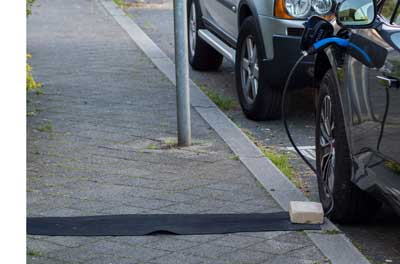 Electrical Cord #1. Regarding the extension cord over the sidewalk, used to charge an EV parked on the street. If there is no specific rule disallowing an extension cord, how can we fine the person? –James R. Electrical Cord #1. Regarding the extension cord over the sidewalk, used to charge an EV parked on the street. If there is no specific rule disallowing an extension cord, how can we fine the person? –James R.
RESPONSE: You don't need a rule that states, "No extension cords on sidewalks." You can use the nuisance provision in your CC&Rs for the violation. In addition, I recommend amending your Rules & Regs to add a provision for safety violations. You don't need to list every conceivable safety violation; simply state that safety violations will result in fines of up to $_____. It gives you the flexibility to levy an appropriate fine for different safety violations.
Electrical Cord #2. You said the homeowner could be fined each time he ran an electrical cord across the sidewalk. I thought we could only fine $100 per violation. Thanks for kicking the SB 130 horse again for me. I don't think it's dead yet. Worst legislation ever. -Ellen V.
RESPONSE: I agree, SB 130 was the worst legislation ever. If the owner leaves the electrical cord across the sidewalk (covered by a mat) that way indefinitely, it is a "continuing violation." Under those circumstances, you put the owner on notice of the violation and give him an opportunity to cure it before the violation hearing. If he removes the cord and does not put it down again, no fine is levied. If he refuses, you levy a $100 fine and threaten legal action.
If, however, he puts the cord down each time he needs to charge his car, and removes it when it's charged, each incident is a separate violation, and a $100 fine may be levied each time it happens. If you deem it a safety violation, which I do, and your rules provide for safety violations, the $100 cap is lifted, and you can charge larger fines. If he ignores the fines and continues to create a safety hazard, a lawsuit may be needed.
Electrical Cord #3. Can associations issue fines and/or impose penalties without a hearing? -MG
RESPONSE: No, they can't. Due process requires notice of each violation and opportunity for the owner to defend him/herself before the board.
Electrical Cord #4. Covering the cord with a rubber mat would pose a major problem with heat dissipation. No electrician would allow that. –Mike K.
RESPONSE: The owner should trade in his Cybertruck for a smaller electric vehicle that fits in his garage, or buy a gas-powered vehicle.

|
|
DISCLAIMER. Our newsletter provides commentary, not legal advice. Boards needing legal advice should have an attorney review the facts and law for their particular situation. We serve as corporate counsel to California associations.
|
|
|