 Origin of the Davis-Stirling Act (2-Minute video)
|

America's first common interest developments? Cliff dwellings built
600 to 1300 A.D. by the Anasazi Indians (from Navajo meaning "ancient ones")
|
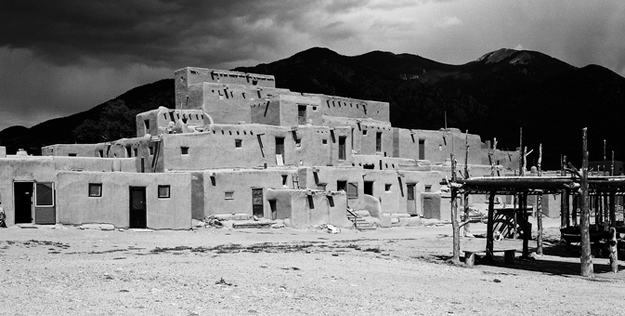
Other early native American condominium-like structures.
|
Early 1900s: TRUST APARTMENTS. Some of the earliest forms of community living were organized as trusts. The trust property was the building and land, the trustee was a bank or financial institution that handled collections and bill-paying for a fee, and the occupants of the building were the trust beneficiaries. Instead of buying their apartment, they would buy into the trust and, in exchange, receive a contract giving them the right to occupy the apartment for as long as they remained trust beneficiaries.
1900 to 1945: COOPERATIVE APARTMENTS (CO-OPS). As some experimented with trusts, other developers used the corporate model, i.e., a corporation owned the entire property and issued shares of stock to buyers. Stockholders leased their units. Financing was difficult because lenders could not hold the property as security for the loan. Some lenders would hold the stock certificates as collateral, but the purchasers frequently had to pay cash.
1917 OAKLAND, CALIFORNIA: The first common interest development (CID) west of the Mississippi was founded in Oakland, California. In June of 1917, Mr. Wickham Havens, then President of the Lakeshore Highlands Company, filed the first of several subdivision maps for a residential development to be built within a laurel-lined canyon and hillside area, formally known as Indian Gulch. The Lakeshore Homes Association was incorporated on October 4, 1917. "The whole intent and purpose in creating and structuring the Lakeshore Homes Association was to place in the hands of the residents and property owners themselves, the complete supervision and control of the various questions affecting the general welfare of the neighborhood."
1928: NEW JERSEY. Radburn, a garden city in New Jersey, was developed as a combination of separate homes, condominiums, and townhouses. Its CC&Rs provided for assessments and architectural and landscaping controls.
1936: LOS ANGELES, CALIFORNIA. On May 14, 1936, the Palos Verdes Corporation created one of the first phased planned developments in California. The Rolling Hills Community Association, a gated community with private roads and bridle trails, began with an initial development of homes on 5-acre parcels zoned for horses. An additional 56 tracts of homes were annexed into the association through 1969, when the development was completed.
1945 to 1965: COMMUNITY APARTMENTS (Own-Your-Owns). After World War II, common ownership of property shifted to a form known as Community Apartments, also called "Own-Your-Own Units." Instead of a corporation owning the entire project, buyers owned it as tenants in common (both the units and the common areas). Financing remained difficult because lenders could not secure loans against an individual unit.
1961 to Present: CONDOMINIUMS. Because of financing problems, common ownership changed in the 1960s to condominiums, in which buyers actually owned the airspace of a particular unit, which permitted lenders to secure loans against real property that could be foreclosed in the event of a default. Owners hold title to the airspace of their unit with an undivided percentage interest in the common areas as tenants in common with other owners. When Congress passed the National Housing Act of 1961, making federal mortgage insurance available to condominiums, the construction of condominiums surged.
Higher Density Plus Amenities. Common interest developments grew in popularity with developers because they could increase density by building more homes on a parcel of land. In addition, they could include amenities to attract buyers, such as clubhouses, pools, and gyms. Initially, associations were unincorporated and governed by an elected board of governors. Eventually, all new associations were established as nonprofit mutual-benefit corporations with elected boards of directors responsible for maintaining the common areas, collecting assessments, and enforcing the governing documents. In September 1963,
 |
Hon. Lawrence
Stirling |
| |
 |
Prof. Katharine
Rosenberry |
1963 California Condominium Act. Common interest developments were first regulated in California in 1963 with the passage of the California Condominium Act. It gave the Commissioner of Corporations jurisdiction over condominiums. (Cal. Stat. 1963 ch. 850, §§ 1-5 at 2090.) In 1965, jurisdiction over condominiums was vested in the Division of Real Estate. (Cal. Stat. 1965, ch. 988, §§1-9 at 2610.) However, the laws affecting homeowners' associations were scattered throughout the Corporations Code and the Civil Code and did not adequately address the unique issues posed by community associations
1986 Davis-Stirling Act
Through the efforts of Assemblyman Lawrence W. Stirling, the legislation's author, and law professor Katharine Rosenberry, who drafted the Act's language, a comprehensive body of law governing common interest developments was enacted in 1985. Assemblyman Gray Davis who chaired the Housing Committee and later became Governor of California, added his name to what became known as the Davis-Stirling Common Interest Development Act. The legislation was signed into law by Governor Deukmejian on September 18, 1985, and went into effect on January 1, 1986, as Civil Code §§ 1350-1374.
Task Force. A "Task Force" of attorneys and management professionals assisted with drafting legislation that created financial safeguards, disclosures, insurance protections, and reserves in a framework that allowed community associations to govern themselves through elected representatives in each community. Task Force members were: Peter Saputo, Gary Aguirre, Curtis Sproul, David Van Atta, Michael Packard, Melinda Masson, F. Scott Jackson, Brian Greenberg, and Wayne Hanson.
Davis-Stirling Rewrite. Each year since the Act's passage, the legislature has amended, revised, and added to its numerous provisions. Due to the growing length and complexity of the Davis-Stirling Act, the California Law Revision Commission, under the leadership of attorney Brian Hebert, reorganized and renumbered the Act into Civil Code §§ 4000-6150. The rewrite took effect January 1, 2014. Whereas the original Act was only 25 pages long, the Rewrite was 100 pages long with an additional 100 pages dedicated to a separate Commercial & Industrial Common Interest Development Act (which previously was a small section in the original Davis-Stirling Act).
2004 Davis-Stirling.com. Larry Stirling later joined Adrian Adams to form the law firm of ADAMS|STIRLING. Adrian Adams made the law more accessible to board members and managers by creating www.Davis-Stirling.com.
Summary of the Act. The Davis-Stirling Common Interest Development Act, also known as the Davis-Stirling Act, is a body of law that governs California condominium, cooperative, and planned development communities, known as common interest developments, regardless of when they were developed. Common interest developments are residential real estate developments where exclusive rights of use or ownership of land are coupled with real property rights owned or enjoyed in common with others.
|
|