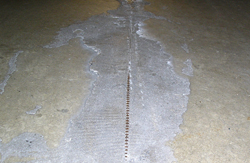
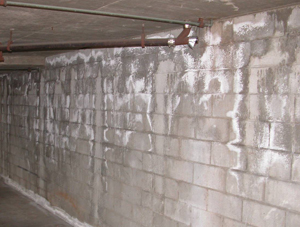
Buildings with subterranean garages sometimes show signs of water infiltration, such as leaks, rust, and spalling concrete. Rebar rusts when it is attacked by water. Rust takes up more volume than normal iron, so it expands and breaks the surrounding concrete. Cracked concrete often creates further water infiltration, causing more rust, and so the cycle continues.
Associations sometimes use band-aid patches that only postpone much-needed repairs. A common band-aid is installing troughs to catch water leaking from garage ceilings or even falling chunks of concrete. Ceiling leaks are obvious signs of needed concrete deck repairs.
Is it possible to fix a leaking structural deck from below? If you had a roof leak in your home, would you paint the ceiling? Typically, these efforts only move the water to another location and do not solve the problem. Ultimately, over many years, the deck's structural integrity becomes compromised. When garage ceilings start leaking, associations need to find and repair the problems at their source, not repair the symptoms underneath.
 |
|
 |
| Spalling & exposed celing rebar |
|
Efflorescence from leaks |
Thank you to Bart Mendel of Stonemark Construction Management for providing this information.
Post Tension Slabs. Many concrete subterranean parking structures serving condominium or apartment developments are constructed using “post-tensioning” technology. This technology reinforces the thin concrete slabs with highly stressed wire cables (tendons) that pre-compress them for structural integrity. The design and construction of these parking structure slabs often incorporate “pour strips” internally and around the perimeter of the garages to allow tendons to be tensioned. The structural integrity of the concrete slabs is highly dependent upon the integrity of the anchorage devices for the tendons placed at each edge of the “pour strip”.
Poor Ventilation Deterioration. These underground parking structures are often poorly ventilated, allowing a build-up of carbon dioxide in the trapped air. This initiates an increase in acidity (a reduction in pH) in the concrete, resulting from high levels of carbon dioxide from auto exhaust mixed with high ambient temperatures. This process, known as carbonation, results from atmospheric carbon dioxide reacting with the moisture in the concrete, converting the high-pH calcium hydroxide to calcium carbonate, which has a more neutral pH. When carbonation in the concrete slabs reaches the depth of the reinforcing steel and/or post-tensioning tendon anchors, the protective passive oxide layer on the steel is no longer stable. As the pH drops below 9.5, the cement's natural corrosion-inhibiting property is lost, and the potential for corrosion of the reinforcing steel, including tendon anchors, increases.
Path of Damage. The construction joints at each edge of the pour strips provide a penetration path for carbon dioxide (present in high quantities from auto exhausts in the garage) and chlorides (present in water seeping from the perimeter walls), These elements change the properties of the concrete (lowering the pH from 12 /13 to as low as 7) and reduce the natural protection of the concrete for steel reinforcements. The consequences of tendon anchorage failure can be sudden and catastrophic.
Controlling Damage. The carbonation and corrosion problems discussed herein can best be controlled through cleaning and preparing the pour strip and adjacent surfaces, and applying anti-corrosive solutions to the top and bottom surfaces of the pour strips that will migrate and react with the cement and steel to reverse and inhibit carbonation, steel corrosion, and reduce concrete porosity.
Safety Considerations. Condominium, townhouse, and highrise construction often incorporate post-tensioned concrete. This raises serious concerns for owner remodel projects and general maintenance issues. Careless drilling through a concrete slab could result in injuries and serious degradation of the slab's structural strength.
Description of Post-Tensioning. Concrete is a material with incredible compressive strength but limited tensile strength. Prior to the development of post-tensioning techniques, the effectiveness of concrete was limited to short spans. The advent of post-tensioned concrete allowed longer slab spans and thinner sections. In post-tensioned construction, steel cables are placed in the slab and stretched from one end to the other. The cables are secured at each end with anchoring systems made of steel castings. When tensioned (stretched) and locked off to the anchors, the post-tensioned system (i) increases the capacity of the slab and (ii) reduces "sag" by lifting the slab. This allows slab spans to increase and/or slab thickness to decrease.
Maintenance considerations for associations include the following:
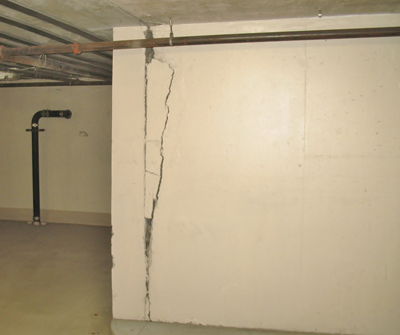
| Shortening: Because they are “pre-compressed”, post-tensioned slabs continue to shorten for a 3 to 5-year period after initial construction as they cure. Rigid elements connected to the slabs, such as concrete or masonry walls, may develop shear cracking during this time. As shown in the photo, the shortening of the slab can create maintenance issues for the wall and other connected elements. While some cracking is acceptable, excessive cracking can result in spalling concrete and allow moisture to reach the reinforcing steel, causing rusting of the rebar and continued deterioration of the concrete and masonry elements. |
|
 |
| Deterioration of the Anchors: After tensioning the cables, the initial shortening effects are greater during the 14 to 60-day period. This often results in the use of delay strips, typically 30 inches wide in the slabs, filled with concrete 30 to 60 days after post-tensioning. Because these delay strips contain the anchor plates for the tendons, and there is ongoing shortening within the slabs, it is very important that the delay strips are properly sealed and maintained to prevent carbonation, water entry, and anchor plate deterioration. As the slabs continue to shrink over time, the delay strips are critical areas to monitor and maintain regularly. Improperly sealed joints, especially those suffering from deferred maintenance, are susceptible to moisture and water infiltration. Excessive moisture can damage the tendon anchor zones and deteriorate the concrete and reinforcing steel. |
|
 |
| Future Construction Coring or Cutting: Post-tensioned tendons are wrapped in a plastic coating to prevent the bond between the tendon and concrete. Unlike conventional rebar, this means that if the tendon is cut or damaged, it loses its effectiveness along its entire length. Therefore, future construction requiring cutting or coring of the slab must proceed very carefully. Such work can be safely performed only after tendon locations have been verified using X-ray or ground-penetrating radar (GPR) equipment. When new projects anticipate the use of post-tensioned slabs, design criteria should be established, confirmed, and specified, noting the maximum length of post-installed anchors (drilled anchors or shot pins) to prevent nicking or otherwise damaging a tendon. As shown in the beam example diagram, the tendons create lift to balance the imposed loads. If a tendon is cut, the “lifting” action is lost, and the beam loses the ability to support loads. This can severely impact the integrity of the post-tensioned system. |
|
 |
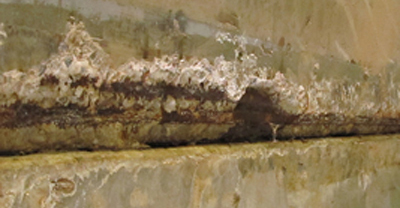
| Weatherproofing: To access the tendon anchors for stressing and locking-off operations, most anchors are located at the perimeter of the slab. Because the tendon anchors around the perimeter of the building are exposed to weather, additional precautions and maintenance inspections are warranted to ensure the anchors are in proper condition. In coastal and tropical, or high-humidity regions of the world, additional concrete cover and corrosion protection are highly recommended to protect both the anchors and tendons. Poorly installed waterproofing or a lack of adequate maintenance of waterproofing membranes, often in planters on the plaza deck of condominium projects, can be as detrimental to tendons as cutting a tendon. As shown in the included photo, the moisture attack on the tendons can result in severe damage and eventually complete loss of the tendons. Fortunately, evidence of this type of damage can be observed, usually in advance of critical failure, during regularly scheduled maintenance programs. |
|
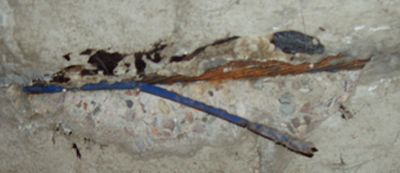 |
Observing Distress in post-tensioned slabs is often an indication that one or more of the above-mentioned issues is of concern. Distress is often manifested by signs of anchor plugs popping out of the slab edge, evidence of rusting along the delay strip seams, spalled concrete, also with signs of rust, and shear cracks in concrete or masonry walls located toward the ends of the slabs. If any of these indicators are observed, a structural engineer should be contacted for an inspection and report.
Recommendation: To protect themselves from potential liability, associations with post-tensioned slabs should adopt written guidelines addressing both maintenance and remodel issues.
-
Remodel Safety. Boards should adopt architectural standards that prohibit drilling, coring, or cutting into concrete slabs without the association's approval, only after cable locations have been verified using X-ray or ground-penetrating radar (GPR) equipment. Owners who alter common area slabs should also sign an agreement holding the association harmless and indemnifying the association in the event that they damage one of the cables.
-
Maintenance & Reserves. In addition, boards should adopt written guidelines for regular inspection and maintenance of post-tensioned slabs. Since maintenance costs will be periodic in nature, they can be incorporated into the association's reserve study. Doing so will also trigger important periodic visual inspections.
Information submitted by Kenneth O’Dell, P.E., S.E. Partner with MHP, Inc. Structural Engineers.
ASSISTANCE: Associations needing legal assistance can contact us. To stay current with community association issues, subscribe to the Davis-Stirling Newsletter.