Benefits of Condo Conversion
 For many reasons, condominiums are generally more marketable than co-ops, which is why stock cooperatives and community apartment (i.e., own-your-own) projects often convert to condominiums.
Although there may be many reasons for converting to condominiums, the primary incentive is greater ease of financing, which leads to higher property values. Instead of a single mortgage on the entire property with shares of stock held by tenants (the stock cooperative model), members actually own real estate in the form of air space bounded by the walls, ceilings, and floors of a unit. This gives owners more conventional collateral for a loan, which makes it much easier to finance as well as buy and sell units. The benefits are summarized below:
- Lenders. Lenders are more willing to lend higher amounts for condominiums than for co-op apartments, and the rates they charge for residential mortgage loans are generally lower than the rates on underlying co-op building mortgages.
- Buyers. Prospective buyers of condominiums don't have the rigorous purchase application and interview processes that co-ops do.
- Lower Dues. Dues are lower because a condominium association's operating budget is generally lower than a co-op's (because it does not include property taxes, which are paid by individual owners).
The downside of conversion is the initial cost. The fees for lawyers and engineers, title insurance, mortgage costs, and other associated costs can be significant. However, the resultant increase in property values can also be significant. Because condominiums have a wider market appeal, they generally sell for 15 to 25% more on average than co-ops.
Conversion Process
There is a difference between a rental apartment building conversion to condos and a co-op or community apartment (own-your-own) conversion to condos. Apartments involve subdivision approval and public hearings through the local city. For co-ops and own-your-owns, most are exempt from the subdivision process and may involve only a minimal application process through the city. Following is an outline of the documents and procedures necessary to convert a stock cooperative to condominiums:
1. Member Approval. Pursuant to Gov. Code § 66452.10, unless the project management documents specify differently, to convert a stock cooperative to a condominium project requires approval by a majority vote of the owners in the project, and trustees or beneficiaries of each recorded deed of trust and mortgagee of each recorded mortgage in the cooperative.
2. Blanket Trust Deed Holder. If a blanket deed of trust is recorded against the stock cooperative, the beneficiary of the deed of trust must be dealt with before a conversion can occur. The loan secured by the deed of trust may be paid off, and the loan reconveyed; the deed of trust may be amended to allow partial reconveyance as each condominium is converted; or the deed of trust may be replaced by a new deed of trust with partial release provisions.
3. Civil Engineering Work. Unless otherwise exempt, the conversion of the Project to condominiums requires compliance with the Subdivision Map Act, necessitating approval of a subdivision map or a certificate of compliance from the city. There is one exemption found in the Government Code that could exclude your project from Map Act requirements. This exception requires:
a. At least 51% of the units were occupied by stockholders of the cooperative (or individually owned) on January 1, 1981;
b. No more than 25% of the shares in the cooperative were owned by any one person on January 1, 1981;
c. A person renting a unit at the time of conversion must be given all rights to which tenants are entitled under state or local law; and
d. The the city (or county) certifies that these requirements are met.
A condominium plan, consisting of a diagrammatic airspace plan of the project units, must be prepared and recorded. If the bylaws or other organizational documents of the stock cooperative do not specify otherwise, a majority of the cooperative's owners must sign the condominium plan.
4. Condominium Management Documents. A new nonprofit "Condominium Association" should be formed to act as the new homeowners' association for the Project once it is converted to condominiums. To implement the conversion to condominiums, it will be necessary to draft a condominium declaration of covenants, conditions, and restrictions and reservation of easements ("CC&Rs") for the project and articles of incorporation and bylaws for the new condominium association. These documents can be substantively similar to the provisions of your existing project management documents, subject to such modifications as are necessary to reflect the condominium form of ownership and to comply with applicable statutes and regulations. If the bylaws or other organizational documents of the stock cooperative do not specify otherwise, a majority of the cooperative's owners must sign the CC&Rs.
5. Condominium Deeds. When the condominium plan and the CC&Rs have been recorded, the Association may then convey each condominium unit to its respective owner by grant deed. If the bylaws or other organizational documents of the stock cooperative do not specify otherwise, a majority of the cooperative's owners must sign the conveyance documents.
6. Trust Deed Amendments. Any trust deed evidencing financing provided to an individual owner secured by a cooperative unit must be amended to revise the legal description of the property being encumbered. Such an amendment must be executed by the unit owner and the mortgagee and recorded in the official records.
7. Department of Real Estate. The Department of Real Estate ("DRE") has asserted jurisdiction over the conversion of a stock cooperative to a condominium project. Hence, the Association must obtain a Final Public Report from the DRE before condominium units may be offered to the members of the association. The following documents must be prepared and submitted to the DRE to complete the conversion:
a. CC&Rs
b. Articles of Incorporation
c. Bylaws
d. Form of quitclaim and lease termination which will terminate each owner's interest in his or her cooperative unit in the project.
e. Form of grant deed conveying a condominium unit to each owner in the project.
f. Form of first amendment to deeds of trust secured by cooperative units in the project which will amend the deeds of trust so that they each encumber the appropriate condominium units.
g. Form of Special Power of Attorney to use to obtain consents of the members and the lenders to the Condominium Plan, CC&Rs, deeds of condominium units, quitclaim deeds and other documents required to convert the project to a condominium project.
8. Additional Costs. Additional costs in the conversion include the preparation of title reports for individual units and miscellaneous recording fees and documentary transfer tax when the quitclaim deeds and condominium deeds are recorded.
9. Timing. The process generally takes 1 to 2 years to complete.
10. Maintenance Responsibilities. Maintenance responsibilities will generally remain the same. Owners will be responsible for maintaining their units, and the association will be responsible for maintaining the common areas.
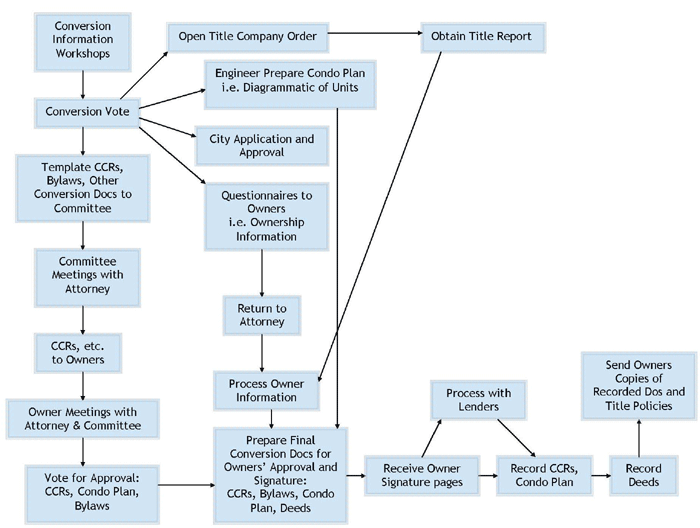
Condo Conversion Flowchart
Stock Cooperative and Own-Your-Own Conversion Flowchart courtesy Timothy Murakami, Esq.
ASSISTANCE: Associations needing legal assistance can contact us. To stay current with community association issues, subscribe to the Davis-Stirling Newsletter.