Faucet Leaks Inside Units
 Faucets and other plumbing fixtures located inside a condominium are the property of the unit owner and must be maintained by that owner. An average household's leaks can account for more than 10,000 gallons of water wasted every year. Common leaks are from worn toilet flappers and leaky faucets. A faucet that drips at the rate of one drip per second can waste more than 3,000 gallons per year.
Because condominiums are on a master water meter, boards can hire a plumber at HOA expense to inspect all units in the complex for water leaks. If done properly, a plumber can compile a complete list of leaky faucets, valves, supply lines, drains, toilets, showerheads, etc., throughout the development.
The list should also include units that need water-saving devices. Arrangements can then be made to repair the property, replace the toilets, and install water-saving devices at a discounted rate for owners if they agree to the repairs. For those who refuse, boards can hold hearings, impose fines, and send lawyer letters to persuade them to cooperate.
Recommendation: Boards should meet with plumbers, legal counsel, and management to set up an inspection/repair program for all plumbing in the development, along with retrofitting with low-water devices.
Toilet Maintenance & Repairs
Allocating responsibility for repairs remains a problem for many associations because most CC&Rs offer little guidance in resolving it. Some help can be found in Civil Code § 4775(a), which states that unless otherwise provided in the declaration (CC&Rs):
- ...the association is responsible for repairing, replacing, and maintaining the common area.
- ...the owner ...is responsible for repairing, replacing, and maintaining that separate interest.
- Unless otherwise provided in the declaration ...the owner ...is responsible for maintaining the exclusive use common area appurtenant to that separate interest, and the association is responsible for repairing and replacing the exclusive use common area.
|
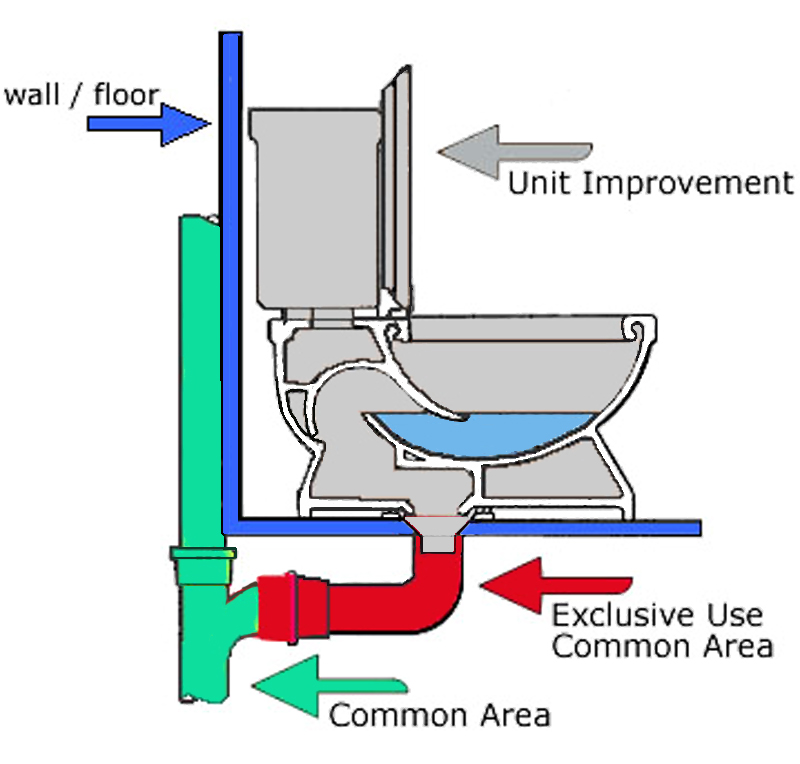
Unit Improvements. Plumbing fixtures, such as a toilet, are improvements to a condominium. In other words, toilets are contained within the unit's airspace, are part of the unit, and are owned by the condominium owner. Accordingly, the owner, not the association, is responsible for maintaining their toilets. If the float in the toilet tank gets stuck, causing the toilet to overflow and damage the common areas, the association is responsible for repairing the common areas, but the owner (or the owner's insurance company) is ultimately responsible for paying for the repairs.
Common Area. The main drain line (in green) is considered common area because it services multiple units. This is the association's responsibility to maintain. The wall and floor (in blue) are also common areas the association is responsible for maintaining. However, the finished surfaces on the walls and floors, such as paint, wallpaper, carpet, linoleum, and tile, are the owner's responsibility to maintain. If the common areas are damaged, who pays for the damage after the association repairs the common areas ultimately depends on who caused the damage.
Exclusive Use Common Area. The wax ring under the toilet and the drain line (in red) are "exclusive use common area" because they exclusively service the owner's toilet. As such, the owner is responsible (depending on your CC&Rs) for maintaining the wax ring and exclusive use drain line, even though they are located in the common area. Unfortunately, many CC&Rs are silent on what constitutes exclusive use of common areas.
Recommendation: To avoid conflict and costly litigation, associations should amend their CC&Rs to clearly define maintenance responsibilities for their exclusive use common areas. At a bare minimum, boards should adopt maintenance policies in their Rules and Regulations.
 Shower Pan Maintenance
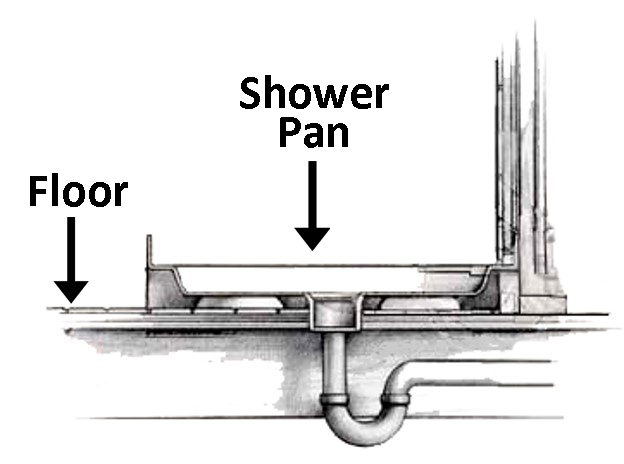
The standard definition of a condominium unit is airspace bounded by the unfinished surfaces of perimeter walls, ceilings, and floors. Anything inside that airspace is an improvement to and becomes part of the unit. This includes paint and wallpaper on walls; carpet, tile, and hardwood on floors; kitchen cabinets and countertops; lighting fixtures; and plumbing fixtures such as toilets, tubs, and sinks.
A shower pan is installed on top of the unit's unfinished floor. (See How to install a shower pan) That means shower pans are inside the boundaries of a unit. As such, they are neither a common area nor an exclusive-use common area. Instead, shower pans are part of the unit and the responsibility of unit owners to maintain, repair, and replace. (Civ. Code § 4775(a)(2))
Recommendation: To minimize disputes and potential litigation, condominium associations should have legal counsel prepare a maintenance chart describing the respective maintenance obligations of the association and members. It helps everyone understand their duties. In addition, many associations need to amend their CC&Rs. When we restate CC&Rs, we include extensive language related to maintenance obligations.
 Angle Stop Valves
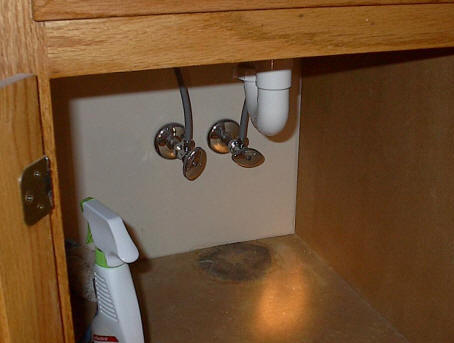
"Angle stops" are shut-off valves that connect the building's water supply to a unit's kitchen and bathroom sinks, faucets, and toilets. Owners are responsible for repairing and replacing their own angle stop valves.
ASSISTANCE: Associations needing legal assistance can contact us. To stay current with community association issues, subscribe to the Davis-Stirling Newsletter.