Stair Inspections and Maintenance
 Reasons for Failure. In most cases, it takes 10 to 20 years for stairs to begin to fail. Failure is most often due to exposure to rain and sun and is accelerated by poor maintenance or poor design. Failure can result in loose stair treads, leading to falls, water intrusion, and dry-rotted wood.
Building Codes. Depending on the extent of the repair, associations may be required to bring the stairs into compliance with building codes. Current codes do not allow stairs to be as steep or narrow as they once were.
Definitions. The following definitions apply to stairs.
- Guardrail: The guardrail is designed to prevent falls from stairs or decks that are more than 30 inches above the ground. Current code requires the guardrail to be at least 42 inches high (it was 36 inches before) and designed to prevent a 4-inch-diameter sphere from passing through it (it was 6 inches before). The current code also requires the guardrail to withstand a 200-pound load applied to its top.
- Handrail: The wood or steel tube or rod that ascends with the stairs. Handrails are required by code on both sides of an exterior stair. There are very few exceptions to this code requirement. They must be of a specific diameter, shape, and distance from the wall or guardrail. They are required to extend past the top and bottom of the stairs and to terminate in a manner that prevents a shirt sleeve or bracelet from getting caught on the handrail.
- Nosing: Where the riser intersects with the tread.
- Risers: The vertical space or surface at the back of each tread that separates one tread from the next tread. Sometimes the riser is open, meaning an object can pass through it. Sometimes the riser is closed. Closed risers comply with current building codes; open risers do not comply. The risers must be consistent in height and meet the current code limit of 4 to 7 inches.
- Stringer: This is the structural beam (wood or steel) that runs parallel to the treads as they ascend. There are times when no visible stringer is present because it is either embedded in a wall or hidden behind finish materials.
- Treads: The horizontal surface of the stairs that you step on. These can be made of pre-cast concrete (made at a factory), steel, wood, or some type of solid (hopefully waterproof) deck coating. The treads must be uniform in depth and have a minimum depth of 11 inches to meet current code.
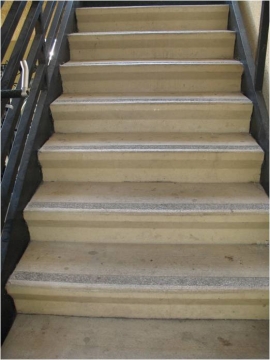
PRECAST CONCRETE TREADS AND RISERS
The tread and riser are formed out of one piece of pre-cast concrete.
|
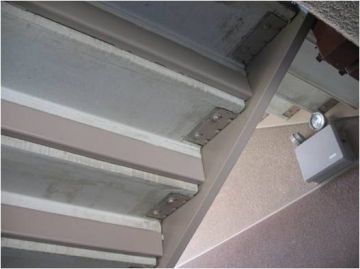
PRECAST CONCRETE TREADS AND STEEL STRINGER
The concrete tread bolts to the steel angle welded to the steel stringer. If these stairs were not under a roof, we would likely see rust where the tread attaches to the steel angle.
|
|
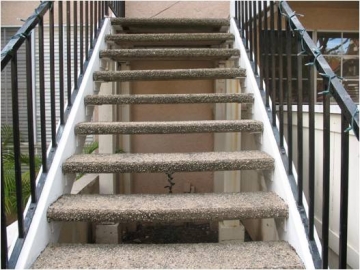
PRECAST TREADS WITH WOOD STRINGERS
This stair does not comply with current codes for tread depth, closed risers, guardrail height, or handrail design.
|
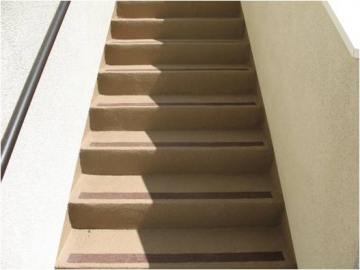
WOOD STAIR WITH WATERPROOF COATING
The stair framed of wood and coated with a waterproof coating. The stringers are hidden in the stucco-coated guardrail walls.
|
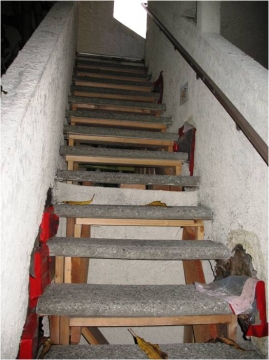
STAIR FAILURE
Water penetrated the stringer where the steel angle supports the pre-cast concrete tread. Thirty years later, there was little wood left to support this stair. The red tape and plastic are the destructive testing holes created to determine the extent of the damage.
|
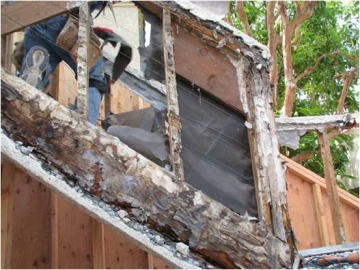
WOOD ROT
The photo above shows extensive decay of the stair stringers and guardrails.
|
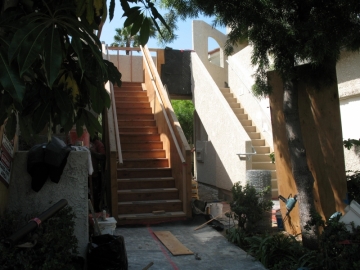
NEW STAIR AND TEMPORARY STAIR
A new replacement stair is being constructed on the right. A temporary stair that allows ingress and egress for second-floor occupants during the construction is located on the left.
|
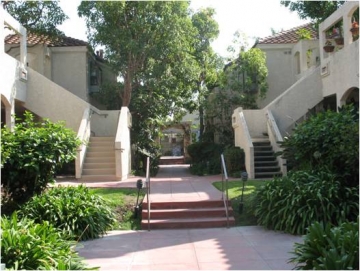
NEW AND OLD
A new stair is on the left, and an old stair is on the right. The new stair is wood-framed with a waterproof coating. The stairs on the right are pre-cast concrete treads connected to stringers covered by the stucco-coated guardrails.
|
Quick tips for managing stairs:
- Stairs with waterproof coating should be inspected annually to confirm the coating has not been compromised by furniture moving or misuse. Pre-cast concrete stairs should be checked during every painting (3 to 5 years, depending on your climate) to confirm that the treads are tight and the stringers are structurally sound.
- Be diligent in maintaining the paint where pre-cast concrete treads touch the stringer and where there are exposed fasteners (bolts, screws, etc.).
- Replacement or repair of treads typically does not require a building permit. With few exceptions, we have found that repairing or replacing stair stringers requires a building permit.
- Prior permit experience with stair replacement or repairs in one city does not guarantee that another city will permit the same stairs. Although the building code is statewide, the building official in each city is the final interpreter of the code.
Thank you to Smith Architects for providing information about stairs.
ASSISTANCE: Associations needing legal assistance can contact us. To stay current with community association issues, subscribe to the Davis-Stirling Newsletter.